
7 Tirada De Las 3 Cartas Gratis Tools for Clearer Readings
Compare 7 tirada de las 3 cartas gratis tools in Spanish, with practical guidance for past-present-future readings and example interpretations.
Start my free readingPublished
Updated
14 min read
Which three-card reading fits your question? A tirada de las 3 cartas gratis works best when you want context, movement, and a possible next step without managing a large spread, and the cleanest starting point is a free past-present-future flow like TarotElya or one of the other tools below. In practice, the best choice depends on whether you want guided interpretation, reversals, themed prompts, learning support, or the fastest possible reading.
The three positions should be defined before you draw. Past gives the earlier pattern, present shows the current tension, and future points to a likely direction, not a guarantee. That distinction matters because tarot here works better as structured reflection and entertainment for adults than as a promise of outcomes. The comparison below keeps that focus and shows which tool is strongest for guidance, learning, speed, reversals, randomness, and reflective framing.
Table of Contents
- 1. TarotElya
- 2. OrigenTarot
- 3. TarotAhora
- 4. Invistools Three-Card Reading
- 5. Tarot.Free
- 6. TarotWise
- 7. Esoterismo Tarot
- Free Three-Card Reading: 7-Platform Comparison
- Turn Three Cards Into One Useful Reflection
1. TarotElya
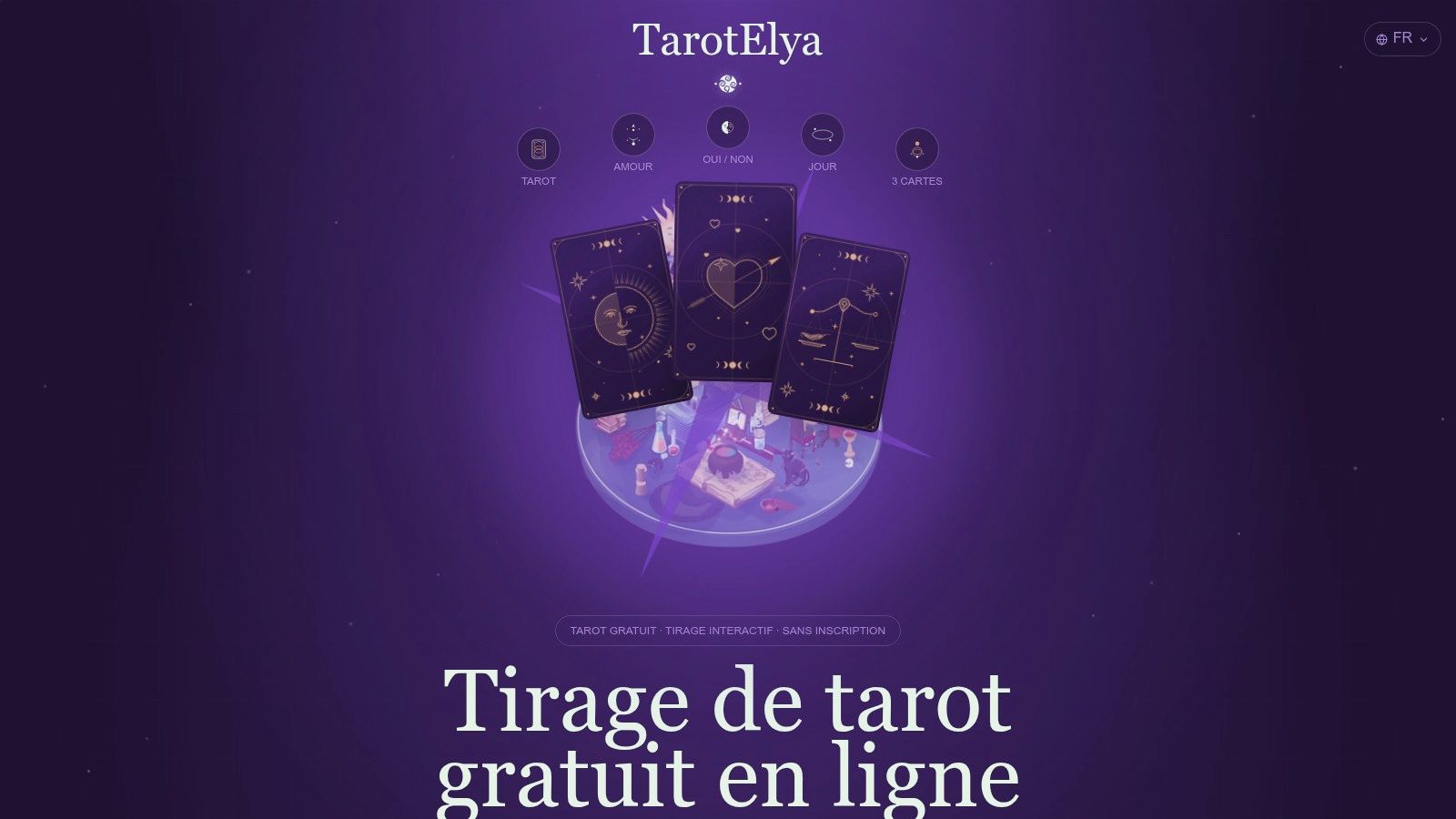
TarotElya is the most complete starting point if you want a free, no-registration tirada de las 3 cartas gratis with a guided feel. The page lets you choose and reveal the cards, so the reading keeps the familiar ritual of drawing rather than jumping straight to a generated result. That interactive flow is a strong fit for mobile, which matters because mobile access is the default path in major markets, and ACMA reports that 97% of adults in Australia used a mobile phone to go online in 2026 and 91% accessed the internet through mobile multiple times a day. For a free three-card reading, that supports a one-screen, low-friction design with fast reveal and short explanations (ACMA report).
Why it stands out for interpretation
TarotElya doesn't stop at the draw. It adds structured reading paths for love, work, money, and personal questions, plus a Yes/No with advice option and a Tarot of the Day format. It also gives beginners real support through Major Arcana keywords, reversed meanings, love/work/money messages, yes-no responses, combinations, and guides, which makes the site more useful than a bare card name and a vague paragraph. The site is also multilingual, with FR, EN, ES, PT, IT, and DE availability, and its “Seen in” section adds visible social proof.
Practical rule: if your question is specific, TarotElya works best when you write that question first, then keep the three positions fixed as past, present, future while you read the output.
Its biggest limitation is also clear. The site is built for reflection and entertainment, not psychological, legal, financial, or medical advice, and it doesn't yet give you a saved reading history. Still, for someone who wants a clean tirada de las 3 cartas gratis plus learning support, it's the strongest all-around choice. The Spanish reading lives at Tirada de 3 Cartas de TarotElya, and the English version follows the same structure at Three-Card Tarot Reading by TarotElya.
2. OrigenTarot
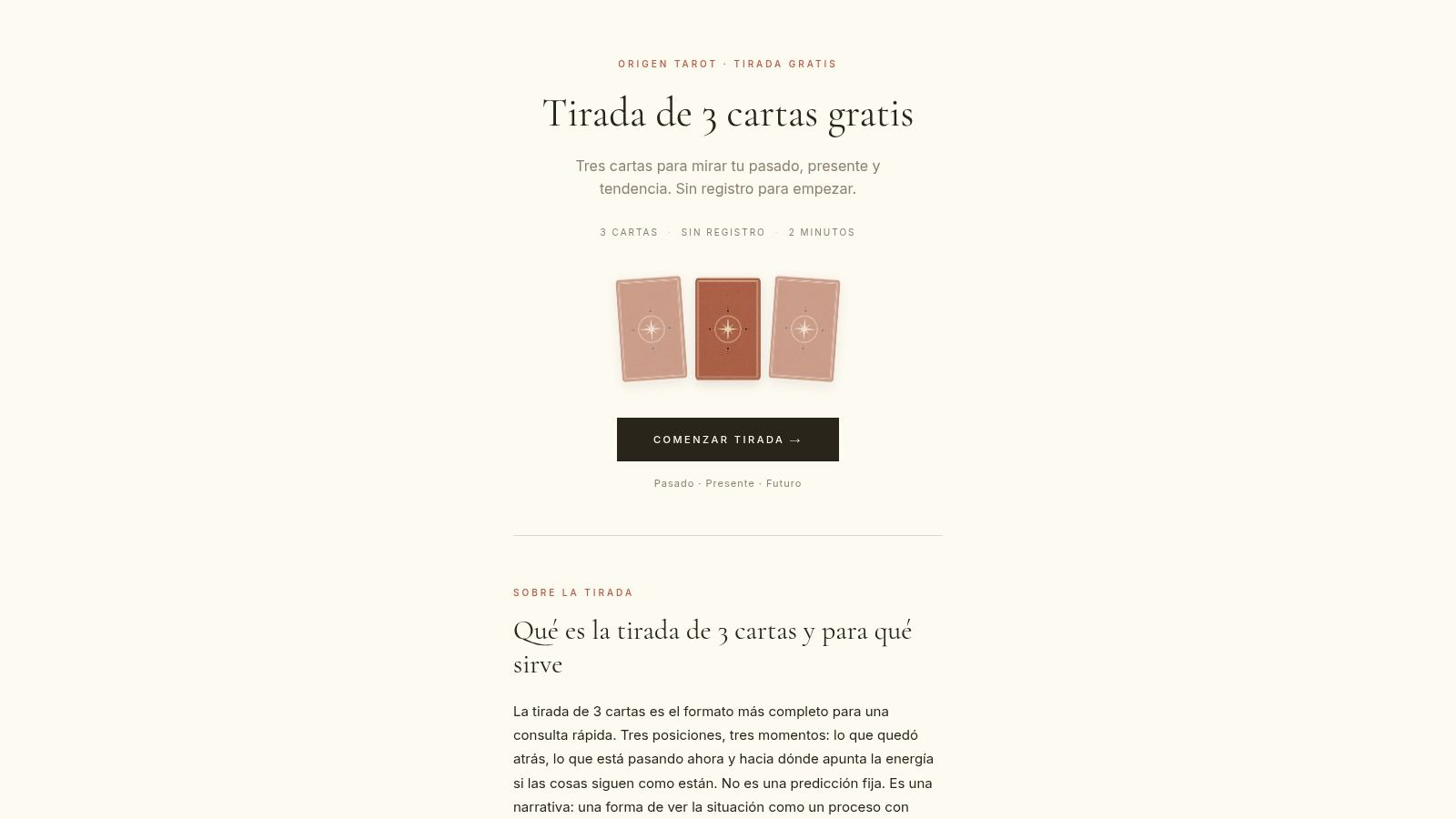
¿Cómo se lee una tirada de las 3 cartas gratis sin perderse en símbolos sueltos? OrigenTarot responde con una estructura clara: pasado, presente y futuro. Cada posición cumple una función distinta, así que la lectura avanza como una frase completa. Primero ubicas el origen, luego observas la situación actual y, al final, miras la dirección que sugiere el conjunto.
La plataforma explica la relación entre las cartas con lenguaje sencillo, lo que ayuda a quien empieza. Un ejemplo corto lo muestra bien. Si la primera carta habla de cierre, la segunda de tensión actual y la tercera de apertura, el sentido no sale de cada carta por separado, sino de cómo se enlazan. Esa forma de leer favorece la comprensión paso a paso.
La herramienta también incluye opciones temáticas para amor, trabajo y dinero. Así, el mismo esquema sirve para preguntas distintas sin cambiar de método. La página abre enseguida, no pide registro y mantiene una interfaz simple para una primera consulta.
Best use case
OrigenTarot funciona bien para quien quiere una lectura guiada y sin exceso de elementos. La terminología es directa y el formato temático ayuda a comparar preguntas parecidas sin salir del marco de tres cartas. Eso resulta útil cuando necesitas pasar de una duda general a una más concreta.
Sus límites son claros. No ofrece elección de mazo, personalización visible ni historial guardado para volver a una lectura anterior. Si buscas profundidad después de la tirada, esa ausencia puede quedarse corta. Si prefieres una entrada limpia y fácil de seguir, visita OrigenTarot's free 3-card tarot reading.
3. TarotAhora
TarotAhora is strongest when you want a free three-card reading that branches into more learning as soon as you draw. Its dedicated “Tres cartas” option follows the familiar past-present-future arc, and each card links to its meaning so you can deepen the interpretation without leaving the reading flow. That makes the site feel more educational than a quick result page.
The site also keeps things open-ended with related spreads like Yes/No, Love, and Celtic Cross. That helps if you start with a three-card spread and then realize the question needs a different shape. The free access and no-registration setup keep the entry point simple, which is important for a first reading when the user only wants immediate context.
The best three-card tools don't just reveal cards, they help you understand how one card changes the next.
TarotAhora's weakness is that the reading flow can feel less focused because ads or extra site modules may compete with the cards. It also doesn't expose deck choice or an obvious reversals toggle in the spread UI. Still, if you value a study-friendly reading with click-through meanings, it does a good job of helping the three positions turn into a coherent narrative. Start with TarotAhora's tiradas page if your version of tirada de las 3 cartas gratis includes learning on the spot.
4. Invistools Three-Card Reading
Invistools stands out for readers who prioritize reversals and randomness quality. The spread uses a full 78-card illustrated deck, supports upright and reversed positions, and relies on the browser's cryptographic random generator, so the draw is less predictable and feels more technically controlled.
The tool also offers separate views for Major Arcana, Minor Arcana, and individual suits. That helps when you want to study one layer of the deck at a time. A student who is comparing card families can use those smaller sets to notice patterns without losing the structure of the full reading. Privacy is part of the design too, because the calculation happens locally and nothing is saved.
Who should pick it
A past, present, future spread works well here because each position has a clear job. The first card shows the starting point, the second card shows the current situation, and the third card shows the direction the reading is moving. For example, a difficult past card, a balanced present card, and a cautious future card can form one story about recovery, not three unrelated notes.
This makes Invistools useful for intermediate readers who already know the basics and want more control over how the spread is built. It asks you to do more of the interpretation yourself, so it suits people who like to compare upright and reversed meanings and then connect the cards into a single thread. If you want more guidance around meanings and combinations, TarotElya's three-card guide gives a more supported starting point. For a more advanced tirada de las 3 cartas gratis, visit Invistools's three-card reading.
5. Tarot.Free
Tarot.Free is the minimal option for people who want a Past, present, future reading without distractions. The page is multilingual, loads quickly, and keeps the interface sparse on purpose. It also promises no account, no fees, and no ads, which makes it easy to use on a phone when you want to get straight to the cards.
The learning layer is built in. The site includes upright and reversed meanings plus yes/no tendencies for all 78 cards, so a beginner can move from draw to interpretation without opening another page. That makes it especially useful if you're trying to understand what each card means in the context of the three positions rather than just reading a summary sentence.
When it works best
Tarot.Free is a strong fit when the question is simple and you don't want a lot of visual noise. It's also useful if you prefer a stripped-down experience that doesn't try to guide every step. The optional AI reading of the exact question adds another layer, but advanced readers may find that part too broad or generic.
Its minimalist design is both the point and the drawback. You won't get deep customization, and you won't get much ceremony around the draw. If you want a pure, fast tirada de las 3 cartas gratis with basic meanings on hand, it does the job well. If you want more interpretation support and a more interactive feel, TarotElya is the better next step. Try Tarot.Free in Spanish if you want speed first.
6. TarotWise
TarotWise is the best fit for readers who want a three-card spread with an optional question field and an AI-supported reading layer. The page is organized around a Spanish past-present-future spread, so the framework stays familiar, but the extra input box helps you define the question before the draw. That matters because a precise question often produces a more usable interpretation.
The site also includes an organized library of Major and Minor Arcana meanings plus other free spreads like Yes/No, Love, Daily, and Celtic Cross. That gives it some range if you start with a three-card reading and later want something broader. The interface is modern and easy to move through, which keeps the focus on the spread itself.
Useful habit: write a short question before you open any three-card spread, then keep that wording fixed until the reading ends.
The main tradeoff is that the AI support can vary in specificity, so the reading may still need your own judgment. It also doesn't show an obvious deck choice or reversals toggle in the three-card UI. Even so, for users who want a smoother interpretation experience than a bare card list, it offers a balanced mix of structure and assistance. Open TarotWise's three-card spread if you want guided input with a modern presentation.
7. Esoterismo Tarot
Esoterismo Tarot is the clearest choice for beginners who want a gentle introduction to the tirada de las 3 cartas gratis. The site uses a simple interactive picker where you hover over and select three facedown cards, and the flow is explained step by step before you draw. That removes a lot of uncertainty for first-time users.
The framing is also important. The site presents the spread as a reflection tool, not a deterministic forecast, which helps set a realistic expectation. It also offers thematic prompts for love, career, and future-focused questions, so the user can choose a direction before drawing instead of staring at a blank layout.
Why beginners like it
The page gets you from landing to draw quickly, with minimal clutter and clear instructions. That makes it easy to trust the process, especially if you're new to tarot or only want a short reading. The downside is that it doesn't offer reversals or a broad library of advanced features, and its post-draw interpretation is less detailed than more encyclopedic sites.
For a reader who wants calm pacing and simple language, that tradeoff can be fine. If you want more educational depth after the draw, TarotElya gives you stronger card resources, combinations, and guides. For an accessible, low-friction entry into the format, see Esoterismo Tarot and compare it with TarotElya's guide to making a tarot spread.
Free Three-Card Reading: 7-Platform Comparison
| Service | Implementation / Complexity 🔄 | Resource needs / Speed ⚡ | Expected outcomes ⭐ | Ideal use cases 💡 | Key advantages 📊 |
|---|---|---|---|---|---|
| TarotElya | Low, interactive draw, mobile-first, no auth | Minimal, instant access; mobile optimized | Engaging & structured insights ⭐⭐⭐⭐ | Quick personal reflection; beginner learning | Interactive draw, multilingual guides, varied readings |
| OrigenTarot | Low, guided past/present/future with narrative focus | Minimal, mobile-friendly, no registration | Clear relational interpretations ⭐⭐⭐ | Beginners wanting structured three-card readings | Emphasizes card relationships; themed variants |
| TarotAhora | Low, multiple free spreads with in-page links | Minimal, free access; possible ads | Informative with easy lookup ⭐⭐⭐ | Users exploring many spreads and meanings | Every card links to a 78-card guide; varied spreads |
| Invistools – Three-Card Reading | Medium, cryptographic RNG, reversal handling | Moderate, richer features; local computation | Accurate, reproducible draws ⭐⭐⭐⭐ | Intermediate users valuing technical fidelity | Crypto RNG, upright/reversed meanings, arcana/suit variants |
| Tarot.Free | Low, minimalist UI with optional AI readings | Minimal, fast, no ads/fees | Clean, concise readings (AI varies) ⭐⭐⭐ | Distraction-free mobile use; new readers | No ads/fees, upright/reversed encyclopedia, AI option |
| TarotWise | Low–Medium, AI-assisted, optional question field | Minimal, modern UI, multiple spreads | Contextual readings (AI specificity varies) ⭐⭐⭐ | Users wanting AI context plus multiple spreads | AI support, organized library, many related spreads |
| Esoterismo Tarot (Esotarot.org) | Low, simple facedown picker with prep steps | Minimal, very fast, minimal flow | Reflective prompts and brief interpretations ⭐⭐ | Complete beginners seeking guided reflection | Approachable copy, step-by-step prep, minimal clutter |
Turn Three Cards Into One Useful Reflection
A three-card spread becomes more useful when you treat it like a short story. Write one specific question, assign the positions as past, present, and possible future, draw the cards without changing the wording, reduce each card to one key image or action, and connect those three notes into one sentence. That keeps the reading grounded in a single thread instead of three separate ideas.
A simple example helps. If the past card reflects an earlier pattern, the present card shows the current tension, and the future card points to a direction that still depends on choices and circumstances, then the spread is giving you a map, not a promise. That's the right way to read a tirada de las 3 cartas gratis, because the value sits in the interpretation you can test against real life.
Record the cards and your first interpretation in a note or journal. Then compare the reading with what happens, especially when you use the same question again later. That habit keeps tarot in the category of personal reflection and entertainment, where it can still be thoughtful, useful, and honest.
If you want one place to start, choose TarotElya when you want a guided, free, no-registration reading with supporting card resources and a mobile-friendly flow. It gives beginners enough structure to learn and gives experienced readers a clean way to ask a question, draw, and interpret without friction.
If you want a free, interactive tirada de las 3 cartas gratis with no registration, TarotElya is built for exactly that kind of reading. It also gives you card meanings, combinations, and guides, so you're not left guessing after the draw. Visit TarotElya and try a three-card reading when you want a clear starting point.