
What Is Tarot Card Reading? a Complete Guide
Discover what is tarot card reading, how readings work, and why people use the 78 cards for reflection and guidance today.
Start my free readingPublished
Updated
16 min read
A tarot card reading uses a 78-card deck to explore a question through symbolic interpretation and personal reflection. It's generally used for guidance and self-reflection, not as a literal system for predicting a fixed future.
You might be deciding whether to apply for a new job, wondering how to approach a difficult conversation, or feeling stuck between two reasonable choices. The question may seem small, but it keeps returning while you make coffee, scroll through your phone, or try to fall asleep. You open a tarot app or shuffle a physical deck, hoping the cards will tell you what to do.
A useful reading doesn't remove your responsibility for the decision. Instead, it gives your thoughts a structure. You bring the question, a spread gives the cards positions, and the images create material to interpret. The meaning develops from the relationship between those elements and your real circumstances.
That's the practical answer to what is tarot card reading. It's a structured interpretive practice, not a deck of automatic answers. The quality of the reading depends less on finding a “magic” card than on asking a focused question and considering what the symbols bring into view.
Table of Contents
- A Quick Start With a Curious Question
- The 78 Cards That Make Up a Modern Deck
- Where Tarot Came From and How It Changed
- What Actually Happens During a Reading
- Why People Use Tarot for Reflection Today
- Common Spreads and When to Use Each
- Common Misconceptions Worth Letting Go
- Trying Your First Reading Without Pressure
A Quick Start With a Curious Question
Suppose you're considering a job offer. The salary looks appealing, but the commute is inconvenient and the role seems less creative than your current work. You could ask, “Will this job make me happy?” That question carries a lot of weight, but it gives the reading very little room to examine the actual decision.
A more useful question might be, “What should I understand about accepting this job?” or “What factor am I overlooking before I decide?” These questions invite reflection instead of demanding a verdict.
In a tarot reading, you shuffle the cards, select one or more, and place them in a chosen layout. Each position gives a card a specific job. A card in a “challenge” position asks you to notice an obstacle; the same card in an “advice” position may suggest a way to respond to it. The reader then connects the imagery, the card's traditional associations, the question, and the person's context.
What tarot is
Tarot is a symbolic card system used for interpretation. A standard modern deck contains 78 cards, and a reading uses some of those cards to create a visual prompt for thinking about a situation. The cards can encourage you to name an emotion, examine an assumption, compare options, or choose a practical next step.
Research on real-world tarot divination describes readings as co-constructed through symbols, client context, and the reader's interpretation process rather than through a fixed card-to-fate mapping (the empirical investigation of tarot divination). That distinction matters. The card doesn't act like a sealed message that means exactly one thing for everyone.
What tarot isn't
Tarot isn't a diagnostic tool, a substitute for professional medical or legal advice, or reliable proof that a particular future must happen. It also isn't a test of whether you're spiritually gifted. A beginner can work with a deck by observing images, asking good questions, and recording interpretations.
The most grounded approach treats tarot as a guided reflection practice. You can take the insight seriously without treating it as an external command. The cards may help you see your situation differently, but you still evaluate facts, consequences, and your own values.
The 78 Cards That Make Up a Modern Deck
A modern tarot deck contains 78 cards: 22 Major Arcana cards and 56 Minor Arcana cards. The deck works like a visual language, with broad themes, everyday situations, and recurring symbols that can be arranged around a question.
The Major Arcana represent larger human experiences, including beginnings, choice, change, responsibility, uncertainty, and completion. Their appearance may point toward a major pattern or turning point, but the card does not carry the same weight in every reading. Its position in the spread and the question being asked shape that meaning.
The Minor Arcana bring more practical detail. They are divided into four suits, commonly called Cups, Pentacles, Swords, and Wands:
- Cups often relate to feelings, relationships, imagination, and emotional exchange.
- Pentacles commonly concern work, money, health habits, material needs, and practical resources.
- Swords draw attention to thought, communication, conflict, judgment, and difficult choices.
- Wands tend to suggest energy, ambition, creativity, desire, and movement.
These suit associations are starting points, not fixed definitions. A Cup can appear in a work reading if workplace relationships matter. A Sword can appear in a love reading if communication or an unresolved argument needs attention. The question and the card's position determine which part of the symbolic vocabulary becomes useful.
Numbered and court cards
Numbered cards show how a suit's theme develops. They can suggest stages, conditions, or different expressions of that concern. Court cards, usually Pages, Knights, Queens, and Kings, may represent a person, a role, a behavior, or a quality the situation calls for.
A Queen might describe emotional maturity in one reading and a particular person in another. A Knight may point to movement, pursuit, or an impulsive approach without identifying a specific individual. Before consulting keywords, observe the image and ask how it relates to the card's assigned position.
TarotElya's tarot card meanings offers a reference for comparing traditional associations after forming a first impression. Learning the deck means understanding how its parts work together, not memorizing 78 cards as isolated definitions. A question gives the reading direction, the spread gives each card a job, and the card's imagery supplies material for reflection.
Where Tarot Came From and How It Changed
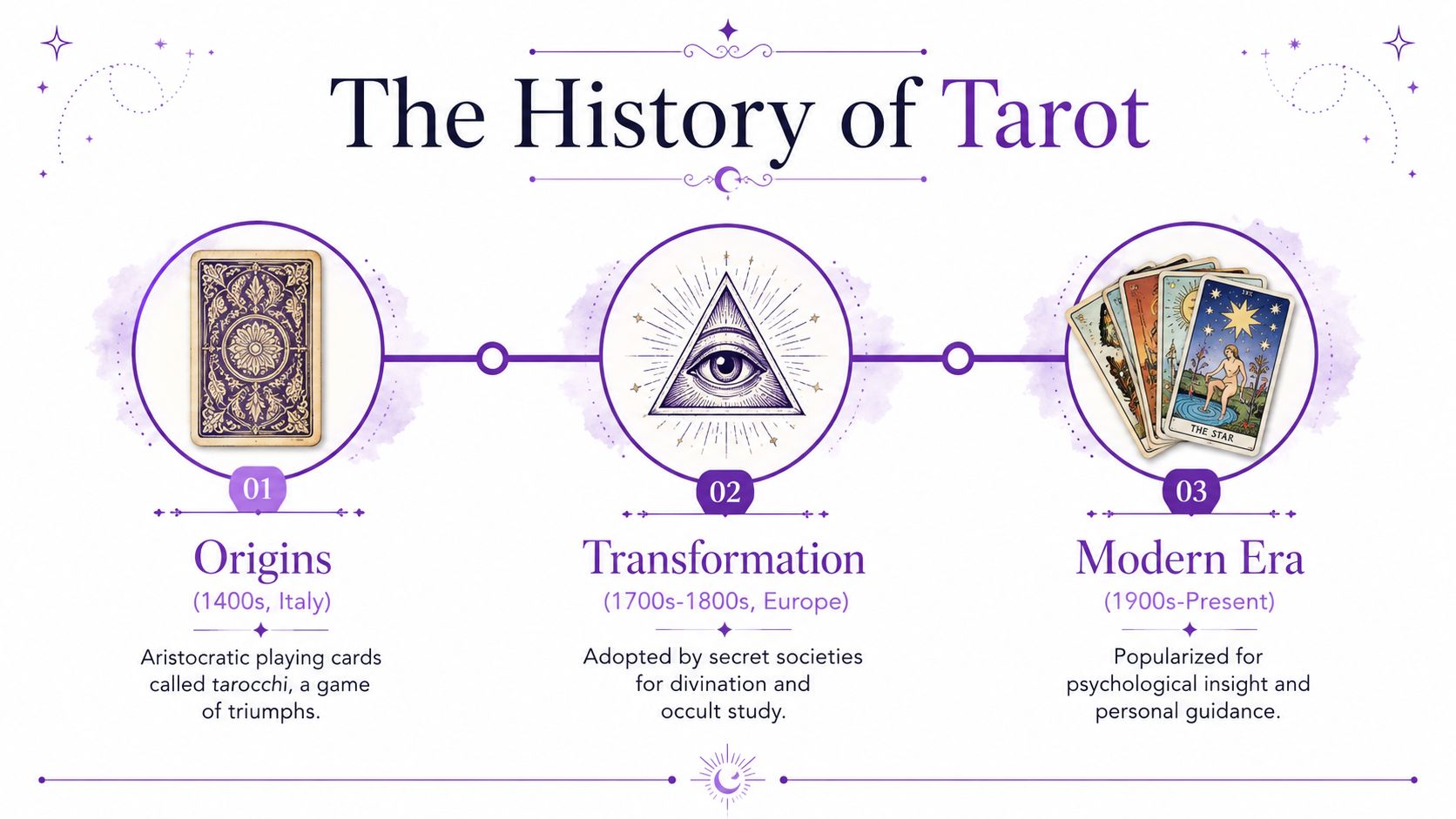
A card deck used for a Renaissance game eventually became a tool for spiritual inquiry. The earliest known tarot cards appeared in the 1440s in northern Italy, where aristocratic players used decks called tarocchi, also described as cards of triumphs (Victoria and Albert Museum history of tarot cards). Their original setting was entertainment, not fortune-telling.
During the 16th century, tarot moved beyond Italy and circulated across Europe. The Marseille tradition later helped stabilize visual patterns that remain familiar today. Printing, regional customs, artwork, and later interpretations each added another layer, much like successive readers writing notes in the margins of an old story.
The shift toward divination came much later. Historical accounts place the first clear documented use for fortune-telling in the late 18th century, roughly 250 to 300 years after the earliest Italian decks. Tarot's esoteric role is therefore a relatively recent practice built on an older card-game tradition.
That timeline clarifies why tarot has no single ancient rulebook. It brings together visual symbolism, narrative layouts, card combinations, and question-based reflection. A reader may approach the deck psychologically, spiritually, creatively, or as reflective entertainment while still recognizing its historical development.
History also explains why a card does not have one fixed function. In a game, its meaning follows the rules. In a reading, the question and layout give it a role, and the reader studies how its image relates to that role. The card is less like a sentence with one definition and more like a word whose meaning depends on the sentence around it.
What Actually Happens During a Reading
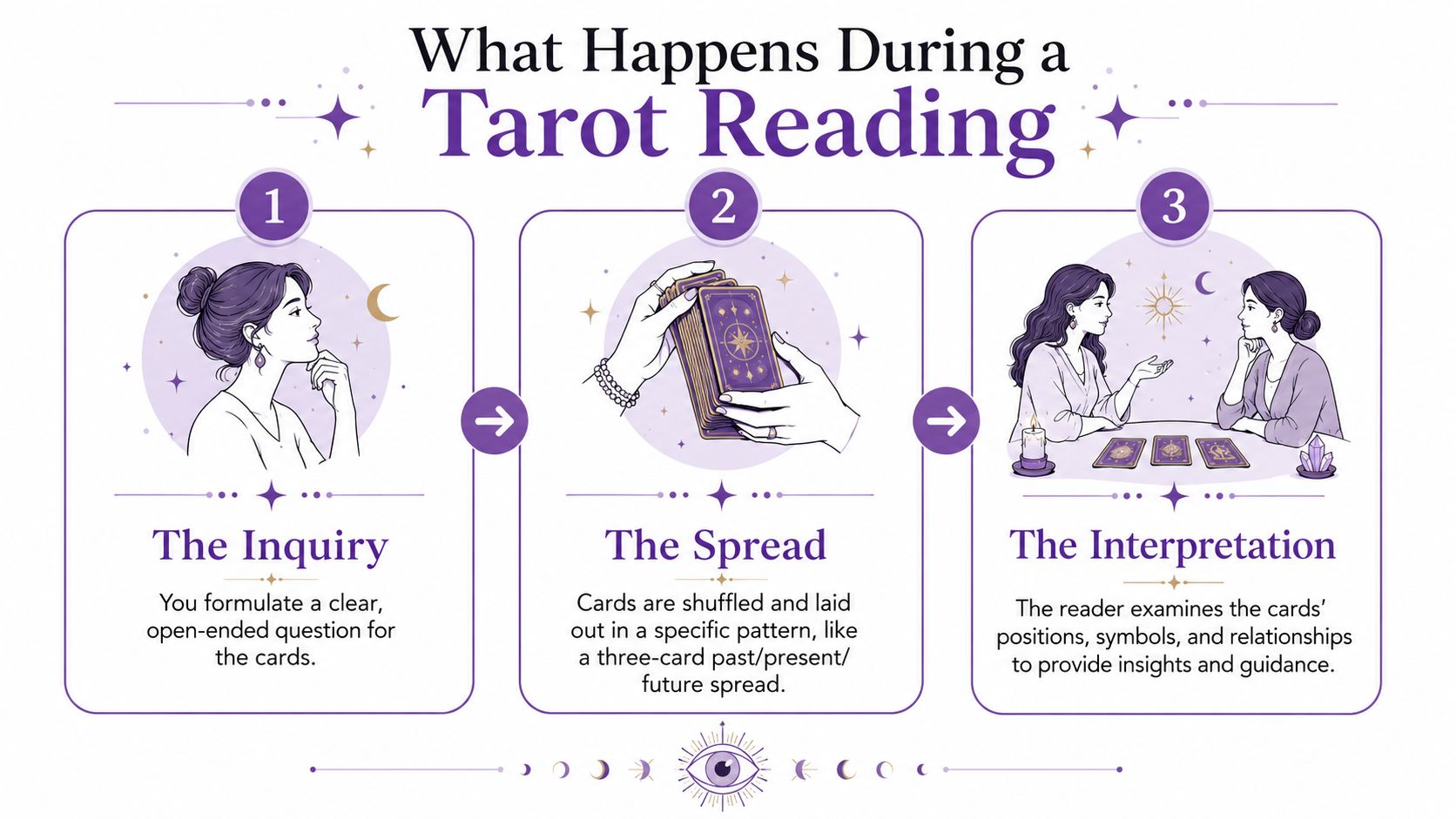
A reading becomes meaningful through three connected variables: the question, the spread, and the card position. Remove any one of them and the process becomes much less precise.
Start with the question. “What will happen to me?” is broad enough to produce almost any interpretation. “What should I consider before accepting this job?” gives the cards a defined subject while leaving room for judgment.
Next, choose a spread. A spread is the layout that assigns roles to the cards. A one-card reading might ask for the central theme of the situation. A three-card layout might examine what shaped the issue, what is happening now, and what direction is available.
Finally, read the position. The card's meaning changes according to the role it occupies. A card associated with movement could describe a past transition, present restlessness, or future momentum. The image hasn't changed. The question and position have.
A running example
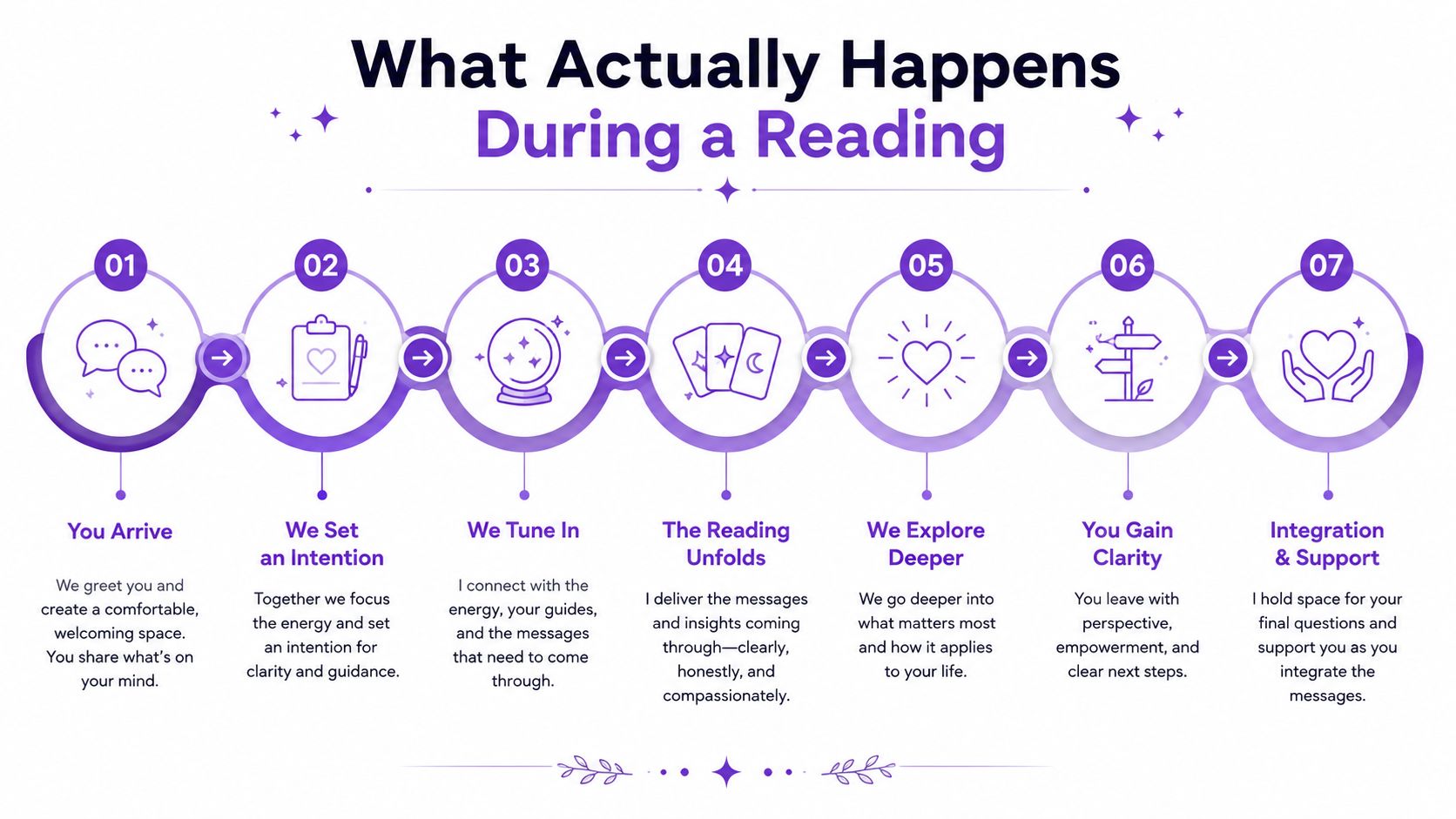
Return to the job decision. You draw three cards for past, present, and possible direction.
The past card might show that you've been carrying frustration from a previous role. The present card could highlight competing priorities, such as income and creative satisfaction. The final card might suggest that progress depends on making a deliberate choice rather than waiting for certainty.
None of those cards proves what will happen. Together, they form a narrative that helps you ask better questions. You might realize that the job itself isn't the whole issue. You're also deciding how much stability you want, what kind of work supports your energy, and whether you're ready to leave an old professional identity.
The same card could read differently in another layout. In a relationship spread, it might describe communication between two people. In a career spread, it might describe a team culture or a decision-making style. A card in an “obstacle” position may point toward a problem, while that same card in an “advice” position may show a useful quality to practice.
Practical rule: Read the card's relationship to its position before applying a memorized keyword.
Interpretation is collaborative
A reader may begin with traditional meanings, but the person asking the question supplies essential context. The image of a closed door might suggest caution to one person and relief to another. A card showing conflict might reflect an external disagreement, an internal debate, or a fear that has not yet been spoken aloud.
A practical guide to doing a tarot reading can help beginners follow the sequence without treating the process as mechanical. Shuffle, draw, observe, connect the cards, and then turn the interpretation into a grounded reflection.
The most useful ending is often a concrete action. After the job reading, that could mean asking the employer about creative responsibilities, comparing commute costs, or writing down the conditions you need before accepting. The cards prompt the conversation. Your evidence and judgment complete it.
Why People Use Tarot for Reflection Today
You are considering a difficult choice, but every argument in your head leads back to the same place. Drawing a card introduces a different kind of prompt: an image, relationship, conflict, or symbol that gives your attention something new to examine.
The card does not contain hidden factual knowledge about your life. Its value comes from your response to it. The image may help you organize thoughts you already have, including thoughts you have not expressed clearly. Even disagreement can reveal something. If you think, “That cannot be right because I want the opposite,” your reaction has identified a preference worth considering.
The mirror metaphor
Readers often call tarot a mirror because the deck directs attention back to the person asking the question. A card may bring grief beneath indecision, ambition beneath fear, or an unspoken boundary into view. The reading creates a pause, allowing those reactions to become easier to examine.
A 2024 systematic review reported associations between tarot sessions and increased self-awareness, improved decision-making, and reduced anxiety and stress (the 2024 systematic review of tarot and psychological effects). These findings support tarot as a reflective practice. They do not establish it as an empirically accurate way to forecast events.
The process is structured sense-making. You ask a question, encounter an ambiguous symbol, describe your reaction, and decide what deserves attention. Tarot works somewhat like journaling with visual prompts, while the spread gives each prompt a position and places the cards in relation to one another. Meaning develops through the question, the layout, and your interpretation together.
Better questions create better reflection
A yes-or-no question can open a useful discussion when it becomes a starting point rather than a command. “Should I move?” leaves many factors undefined. “What would make moving responsible?” directs attention toward preparation, risks, and available resources.
Questions that focus reflection include:
- Clarify the issue: What am I not acknowledging about this situation?
- Examine agency: What can I influence today?
- Compare paths: What should I consider before choosing option A?
- Find a next step: What action would create more clarity?
Write down one concrete action when the reading ends. You might gather information, have a conversation, or define a condition for your decision. That step keeps the session connected to ordinary judgment and prevents an evocative story from replacing planning. Tarot can support reflection, while your evidence and choices determine what happens next.
Common Spreads and When to Use Each
Choose a spread based on the size of the question. A single card can focus attention, while multiple cards let you compare causes, conditions, obstacles, and options. More cards don't automatically produce more insight. They can also create more material to interpret without improving the question.
| Spread | Best For | Typical Positions |
|---|---|---|
| One-card draw | A daily prompt or one focused issue | Theme, advice, or question |
| Three-card spread | A situation with a clear sequence | Past, present, possible future |
| Yes/no reading | A quick orientation around a narrow question | Yes, no, or maybe, plus guidance |
| Five-card situational spread | A decision with several contributing factors | Situation, influence, obstacle, advice, likely direction |
One card for a focused prompt
A one-card draw is useful when you want to explore one quality or action. Ask, “What should I pay attention to in today's conversation?” Then observe the image before consulting a guidebook. Note the first detail that catches your eye and connect it to the question.
Don't ask one card to settle every part of a major life decision. Use it to identify a theme, a concern, or a productive question.
Three cards for movement
The familiar past, present, and future layout gives a situation a timeline, but “future” works best as a possible direction, not a guarantee. You can also use positions such as situation, challenge, and advice.
A three-card tarot reading suits beginners because each card has a clear role while the group still creates a narrative. Read the cards from left to right, then look again at the combination. Ask whether the cards reinforce, complicate, or contradict one another.
Yes or no for a narrow question
A yes/no reading should concern something specific and actionable. “Should I send this application today?” is easier to work with than “Will my career succeed?” Treat “maybe” as an invitation to identify missing information or conditions.
Five cards for a fuller situation
A five-card layout can separate the issue into parts: the current situation, a major influence, the obstacle, useful advice, and a possible direction. You can adjust those roles, but write them down before drawing. Clear positions stop the reading from turning into a search for a convenient meaning.
Common Misconceptions Worth Letting Go
Myth: Tarot predicts a fixed future.
Suppose a reading points to tension around an upcoming choice. That describes a pattern or possible direction, not an unavoidable result. Meaning comes from the question, the spread position, and the surrounding cards, so the reading supports reflection rather than assigning a fixed fate. Research on tarot divination and interpretation
Myth: A difficult-looking card means bad luck.
Images linked with endings, conflict, or uncertainty can show what deserves attention. In an advice position, the same card might invite preparation, clearer boundaries, honesty, or change. A difficult message is not a doomed outcome.
Myth: Reversed cards are warnings.
A reversal is one reading method, not a built-in alarm. Some readers use it to explore blocked, private, delayed, or excessive expressions of a card. Others keep every card upright and let the position provide extra detail. Either approach can work when applied consistently.
Myth: Only psychics can read tarot.
A beginner can study the deck's structure, observe its imagery, ask a focused question, and compare an interpretation with lived circumstances. Intuition can grow through practice, while reasoning keeps the reading grounded. The cards offer prompts, not authority.
Keep a clear boundary around the practice. Tarot should not diagnose illness, make choices for another person without consent, or replace professional support. Used carefully, it creates a structured conversation with yourself.
Trying Your First Reading Without Pressure
Start with one small question, not your entire future. “What should I understand about tomorrow's meeting?” gives you something specific to examine.
Then choose a one-card or three-card spread. Look at the images before opening a reference guide, write down your first response, and finish with one practical takeaway. You can use a physical deck, a journal, or a free interactive online reading as a low-pressure way to learn how question, position, and interpretation work together.
The point isn't to produce a perfect prediction. It's to notice what the card makes you consider and whether that thought helps you act with greater clarity.
TarotElya offers free interactive readings without requiring registration, including one-card, yes-or-no, three-card, love, work, and money formats, along with card meanings, combinations, and learning guides. Visit TarotElya to explore a reading at your own pace and use the interpretation as a prompt for personal reflection and entertainment.