
How to Read Reversed Tarot Cards Without Second-Guessing
Learn how to read reversed tarot cards with practical methods, worked examples and a beginner-friendly decision tree for when to flip and when to skip.
Start my free readingPublished
Updated
13 min read
You've got the Tower on the table, it's reversed, and your first reaction is probably some mix of “Is this worse?” and “Am I supposed to panic now?” That's a normal beginner moment. The good news is that reversed cards don't have to be a mystery test, and they definitely don't have to turn every reading into a negative one.
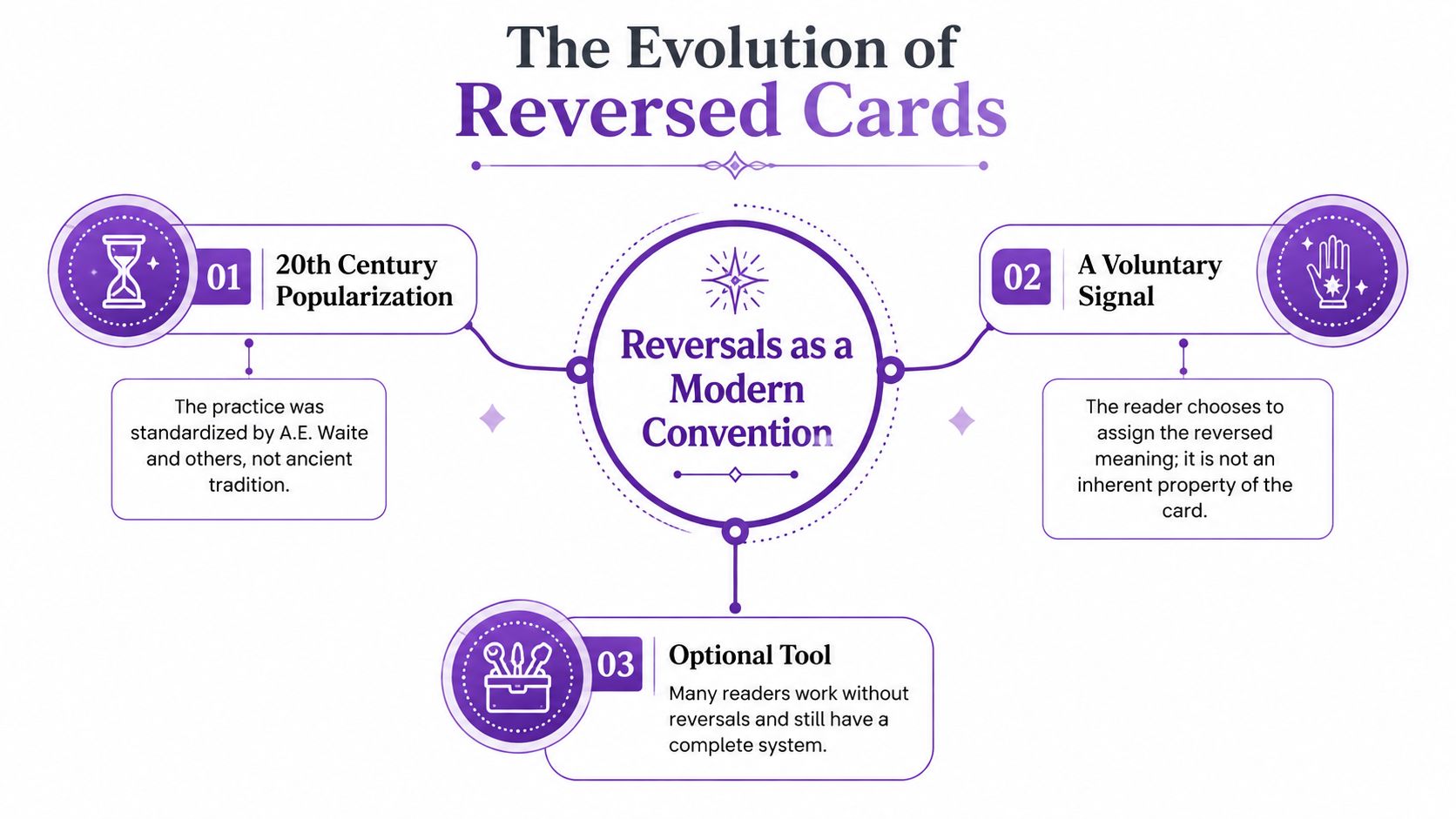
Tarot reversals are a modern interpretive convention, not an ancient rule built into the deck itself. Tarot began as a 15th-century card game in Italy, and for roughly 350 years there were no systematic reversed meanings. The first formal reversal system is generally credited to Jean-Baptiste Alliette, known as Etteilla, whose late-18th-century publications assigned meanings to cards in both upright and reversed positions, and later Arthur Edward Waite's 1909 The Pictorial Key to the Tarot helped normalize upright-and-reversed reading for the Rider-Waite-Smith era as documented here and here.
That history matters because it gives you permission to treat reversals as a tool, not a law. If you learn one simple classification routine first, you won't need to memorize twelve competing systems before your next reading. You'll know what the reversal is doing, and the card stops feeling like a trap.
Table of Contents
- What Reversed Tarot Cards Actually Are
- The Five-Category Reversal Classification
- Polarity, Nuance and Emphasis Compared
- Reading a Reversed Spread in Practice
- How Many Reversed Cards Signal a Bigger Pattern
- Practice Exercises to Build Reversal Confidence
- When to Read Reversals and When to Skip Them
What Reversed Tarot Cards Actually Are
A reversed card is just a card turned 180 degrees from upright when it lands in a spread. Some readers only treat a card as reversed if it's upside down, while others also notice sideways positions, but the core idea stays the same, the card is no longer facing the same direction as the rest of the deck. The reversal only exists because someone shuffled, dealt, and chose to honor orientation as part of the reading.
That makes reversals a voluntary signal. The card doesn't contain a hidden “bad” sticker on the back, and the deck hasn't become less sacred because one image landed upside down. You're deciding that orientation matters, then asking what it adds.
Upright and reversed are just two reading positions
Upright means the card is right-side up to you, the reader. Reversed means the image is flipped, usually upside down, sometimes visually angled enough that your system treats it as reversed. Both are still the same card, which is why the upright meaning remains your anchor.
A beginner mistake is to start with the upside-down position and forget the base card. Don't do that. Read the upright meaning first, then ask what orientation changes about it.
Practical rule: treat the reversal as a change in delivery, not a new card.
That's the mindset that keeps reversals from turning into guesswork. Once you can name the reversal's energy using a small set of categories, the whole process gets easier fast. For many readers, the question stops being “What does every reversed card mean?” and becomes “What is this reversal doing here?” If you want a broader foundation for card reading itself, the basic structure is covered in TarotElya's tarot reading guide.
The Five-Category Reversal Classification
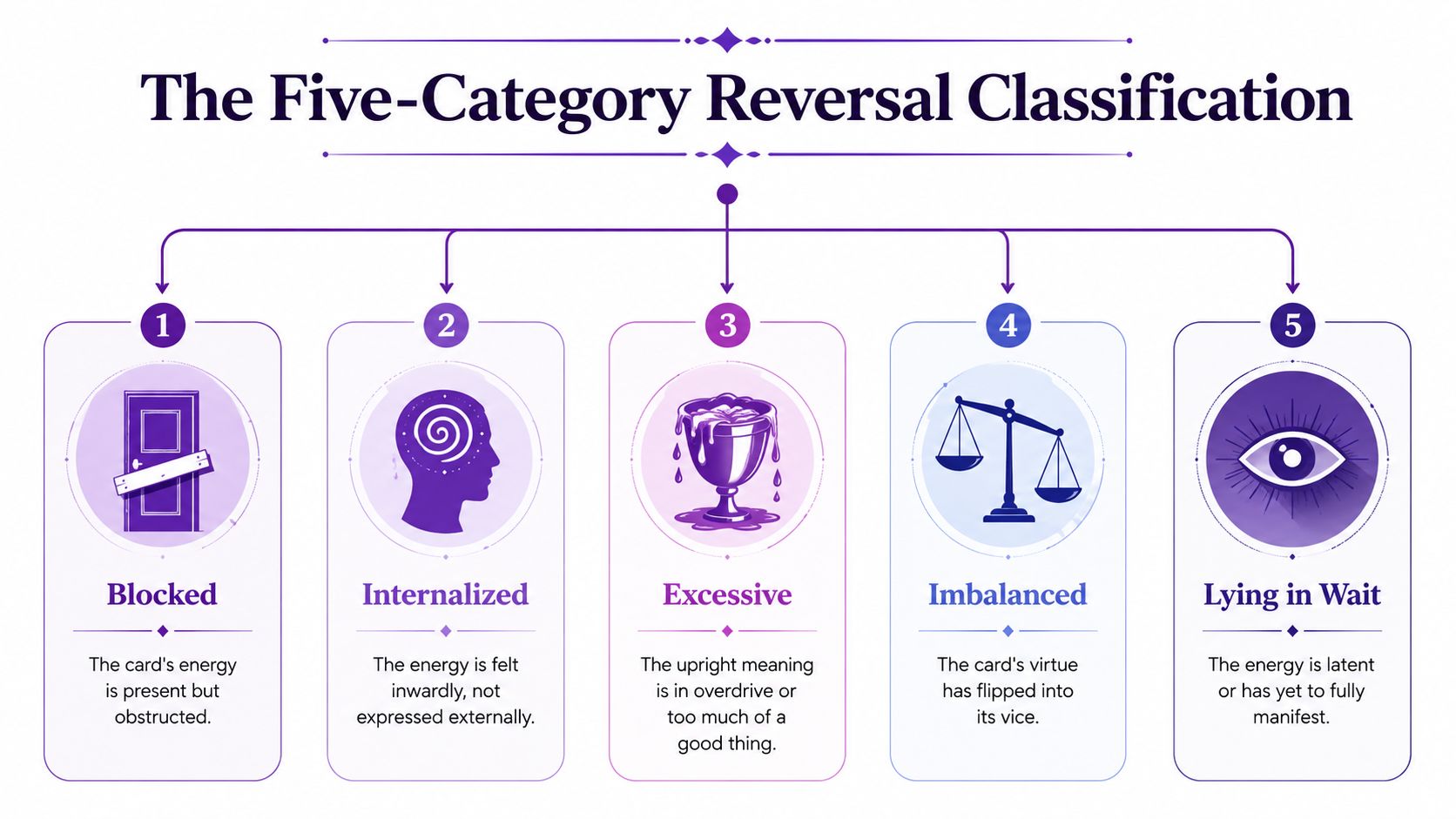
Before you reach for a card-specific reversed meaning, classify the card into one of five buckets. That's the habit that replaces panic with structure. The point isn't to force a card into a box, it's to give your first instinct somewhere reliable to land.
Blocked, delayed, internalized, excessive, opposed
A blocked card means the energy is there, but something is getting in the way. A reversed Three of Swords can point to grief that hasn't moved through yet, not grief that disappeared. The feeling exists, it just isn't flowing cleanly.
A delayed card says the situation is arriving, but it's still in transit. A reversed Ace of Wands often makes more sense as a spark waiting on conditions than as a failure of inspiration. The message is timing, not absence.
An internalized card turns the energy inward. A reversed Hermit can describe private reflection, quiet processing, or wisdom that hasn't been spoken yet. The card isn't silent, it's inward-facing.
An excessive or deficient reading asks whether the upright trait has tipped too far one way or not far enough. A reversed Strength can suggest burnout, overcontrol, or not enough courage, depending on the spread. The card is still about Strength, but the balance has shifted.
An opposed card points toward a real polarity shift. A reversed Sun can indicate dimmed joy, a clouded outlook, or difficulty accessing warmth. Use this category when the reversal reads like a counter-current, not just a softer version.
Here's the easiest way to remember the sequence. First ask, “What is the card trying to do?” Then ask, “What's stopping, slowing, turning inward, exaggerating, or flipping that energy?” That's your working muscle memory.
Polarity, Nuance and Emphasis Compared
Not every reversal should be read the same way. Some cards want a sharp opposite, some want a softened version, and some want the same meaning with a loud underline. If you choose the right lens, the reading gets cleaner immediately.
Three classic approaches side by side
Polarity treats the reversal as the opposite of the upright meaning. It's fast and dramatic, which is why it can work well with Major Arcana cards and emotionally charged moments. A reversed Tower in a crisis spread can absolutely feel like the collapse is redirected, resisted, or arriving in a different form.
Nuance treats the reversal as a gentler, internalized, or lower-intensity version of upright. That's often a better fit for everyday Minor Arcana cards, where the opposite meaning would be too extreme. A reversed Two of Cups usually reads more naturally as reduced harmony, distance, or uneven reciprocity than as outright hostility.
Emphasis keeps the upright meaning intact but makes it louder. This is the lens to use when the card already fits the spread and the reversal seems to say, “Pay attention here.” In a reading where the upright message already resonates, the reversal can sharpen the focus instead of changing the direction.
| Method | What a Reversed Card Means | Best Used For | Watch Out For |
|---|---|---|---|
| Polarity | The opposite of upright | Major Arcana, strong emotional shifts | Can become too dramatic too fast |
| Nuance | Softer, internalized, or reduced upright energy | Minor Arcana, relationship readings | Can flatten a clear reversal into vagueness |
| Emphasis | Same upright meaning, highlighted | Cards that already fit the spread | Can be overused as a catch-all |
A simple rule helps here. Use polarity for Majors, nuance for Minors, and emphasis when the upright meaning is already ringing true. That's not a law, but it's a solid default until your intuition gets steadier. For a fuller reading workflow, the surrounding spread matters just as much as the card itself, as the basic method in TarotElya's reading guide reminds you.
Reading a Reversed Spread in Practice
Start with the question, not the card. If someone asks about timing, relationship change, or a creative block, the same reversal can mean very different things. The spread position tells you what role the card is playing, so the upright meaning comes first and the reversal modifies it.
A three-card reading with the Magician, Empress, and Star
Suppose the cards are reversed Magician, reversed Empress, and reversed Star. In a work reading, the reversed Magician can point to blocked initiative or skill that stays inward instead of becoming action. The reversed Empress can suggest depleted resources, not enough nourishment, or creative output that's running dry. The reversed Star can show hope withheld or recovery delayed.
Read them together and the picture becomes clearer. This doesn't have to mean “everything is bad.” It can mean the person has ideas, but the energy, resources, and confidence aren't moving freely yet. The synthesis sentence might sound like this, “There's capability here, but the project needs support, rest, and a slower pace before it can open up.”
A timing question with the Fool and the Emperor
Now take a spread about next steps. A reversed Fool doesn't always mean recklessness, especially if the position is about timing. It can mean delayed action, hesitation, or a leap that isn't ready yet. The reversal changes the pacing more than the meaning.
A reversed Emperor in an emotional or reflective question can point to internalized authority. That may fit better than “lack of discipline,” which is too blunt for some spreads. The energy is still structured, but it's happening inside rather than being enforced outside.
Useful habit: name the category aloud, connect it to the neighboring cards, then test the sentence against the question.
That last step matters. If your sentence doesn't answer what the querent asked, the interpretation is probably too clever. Keep it plain. Keep it usable. You're not trying to sound mystical, you're trying to tell the truth in language the person can act on.
How Many Reversed Cards Signal a Bigger Pattern
A single reversal usually points to one localized friction point. It deserves attention, but it doesn't automatically redefine the whole spread. Counting reversals becomes useful when you treat the count as diagnostic metadata, not as a warning siren.
For most spreads, two or three reversals suggest a repeated theme. That theme might be blocked action, internal reflection, missing energy, or a process that's happening out of sight. The cards are telling the same story from different angles, so you stop reading each one in isolation and start grouping them.
When the count changes the method
Once three or more cards are reversed, switch from a single-card approach to a pattern-based one. Group the cards by suit, element, number, or repeated symbol, then ask what the pattern says. Reversed Wands can point to scattered motivation, while reversed Cups can show feelings kept private.
Majors can strengthen the pattern fast. If a spread has multiple reversed Majors, the issue may be structural rather than situational, and you should slow down before you settle on a simple answer. A lot of reversals in a large spread can be meaningful, while a similar count in a deliberately shuffled deck may just reflect how that deck moves in your hands.
The key question is whether the pattern clarifies the situation. If the querent's lived reality doesn't support the reversal-heavy story, don't force it. Change methods, reshuffle, or read upright only.
A spread should answer the question in front of you, not reward you for inventing a bigger drama.
That's why density matters less than fit. A reading with many reversals isn't automatically deeper, and a reading with few reversals isn't automatically shallow. The spread's job is to help you understand what's active, blocked, or waiting, not to prove that the deck is difficult. If you want to size spreads more carefully, the basic guidance in TarotElya's card-pulling guide is a useful companion.
Practice Exercises to Build Reversal Confidence
Confidence with reversals comes from repetition, not from reading one perfect explanation and hoping it sticks. You need a routine that trains your eye to classify first and predict second. That's how the meanings start feeling natural.
One-card drills and method comparison
Start with a single card. Write its upright meaning in one sentence, then write five more sentences, one for each category, blocked, delayed, internalized, excessive or deficient, and opposed. Don't worry about being elegant. You're building range, not publishing notes.
Then pull three cards and read them three ways. First use polarity, then nuance, then emphasis. Ask which version answers the question most cleanly, and write down why. This exercise teaches you where your instinct leans and where it overreaches.
A slightly harder drill uses a full spread of Majors. Before you interpret the upright meanings, notice reversal density, repeated symbols, and whether the cards cluster by theme. That habit makes you look for structure before story.
A two-week journaling habit
Keep the notes short. After each practice session, record the question, the cards, the category you chose, one alternative interpretation, and one final synthesis sentence. On odd-numbered days, use cards from a single suit. On even-numbered days, mix the deck.
Review the journal weekly and look for patterns in your choices. Maybe you keep choosing blocked when nuance would fit better. Maybe you overuse polarity with Minor Arcana cards. Those patterns are useful because they show you where your reading style needs correction.
The goal isn't perfect accuracy. The goal is to notice why one interpretation feels tighter than another. Over two weeks, that habit turns reversals from a vocabulary list into a decision process. A tool like TarotElya can support that practice with upright and reversed meanings built into its card pages, but the skill still comes from your own repetition.
When to Read Reversals and When to Skip Them
Reversals are optional. You don't owe them to every spread, and you don't need to force them just because another reader does. The question is whether they add clarity in the kind of reading you're doing right now.
Three checks before you flip the deck
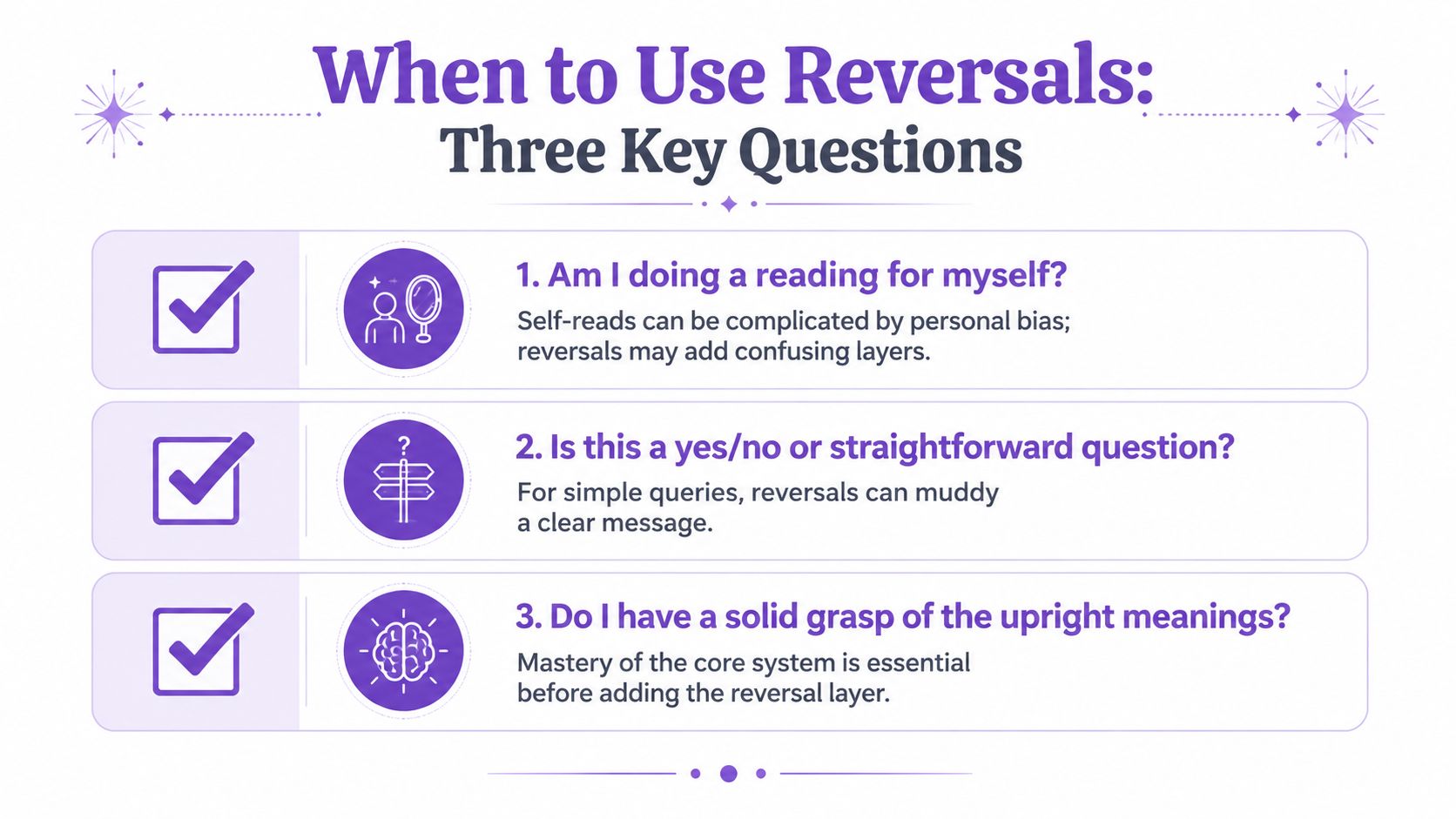
Ask yourself three things before the reading starts. Does the querent expect reversals? If they do, skipping them can leave out signal. Is this a yes/no or straightforward question? If the question is simple, reversals can muddy it. Do I have a solid grasp of the upright meanings? If the base meanings aren't steady yet, the reversal layer can become noise.
Reversals often help in multi-card spreads, journaling practice, and when you're learning a new deck. They can also help when the imagery clearly supports an upside-down read. But they can add clutter in single-card daily draws, already-dense spreads, or when the querent is tired and needs a cleaner answer.
A practical rule works well here. Try reversals for two weeks, then decide whether they made your readings more specific or more confusing. If they sharpened the message, keep them. If they made you hesitate more than you helped, skip them without guilt.
That's the freedom in tarot reading, you get to choose the convention that serves the question. If you want guided practice, clear card meanings, and a reading experience that makes room for both upright and reversed cards, visit TarotElya and use it as a space to test your own reading style until it feels natural.